
Most people who think they have an anonymous domain do not. They paid in Monero, ticked the registrar's WHOIS-privacy checkbox, and trust that their identity is hidden. That belief is correct for the casual observer running a whois lookup. It is not correct for a determined adversary with a subpoena, a court order, or — in the case of the .com namespace — a Verisign trust-and-safety escalation. WHOIS privacy is a layered problem, and a serious anonymous domain is a stack of decisions made deliberately at every layer.
This guide walks the stack. Coin choice, registrar choice, TLD choice, and the operational hygiene that determines whether your privacy holds under pressure. By the end you will know which combinations actually deliver anonymity in 2026 and which only deliver the appearance of it.
The WHOIS problem: what's actually public
Before fixing leaks, know what leaks.
What WHOIS contains by default
For every domain in a gTLD (.com, .net, .org, .io, etc.) the registry maintains a record with the registrant's name, organisation, postal address, email and phone, the administrative and technical contacts, the nameservers, and the registration / expiry dates. Until 2018 this was all public via whois queries with no rate limiting. ICANN and the GDPR forced a partial redaction regime in May 2018, so most modern WHOIS responses for gTLDs now show REDACTED FOR PRIVACY in the personal fields and a forwarding email — but the underlying record at the registrar is unchanged.
The two-layer reality
There are two layers of data: the public WHOIS response, which today is usually redacted, and the registrar's internal record, which still contains the real registrant data and which the registrar must produce under subpoena. ICANN's 2024 RDRS (Registration Data Request Service) gives law-enforcement, IP-holders and "legitimate interest" parties a streamlined path to that internal record. So the question is not just "what does whois show?" but "who can compel the registrar to disclose the unredacted record?".
ccTLDs are a different regime
Country-code TLDs (.is, .ch, .me, .ru, .nl) are not bound by ICANN's gTLD policies. Each registry sets its own rules. Some are stricter than gTLDs (Iceland's .is requires verified identity); some are far more permissive (Russia's .ru accepts pseudonyms; some Pacific .tk-style namespaces require nothing at all). TLD jurisdiction matters more than gTLD-vs-ccTLD as a category.
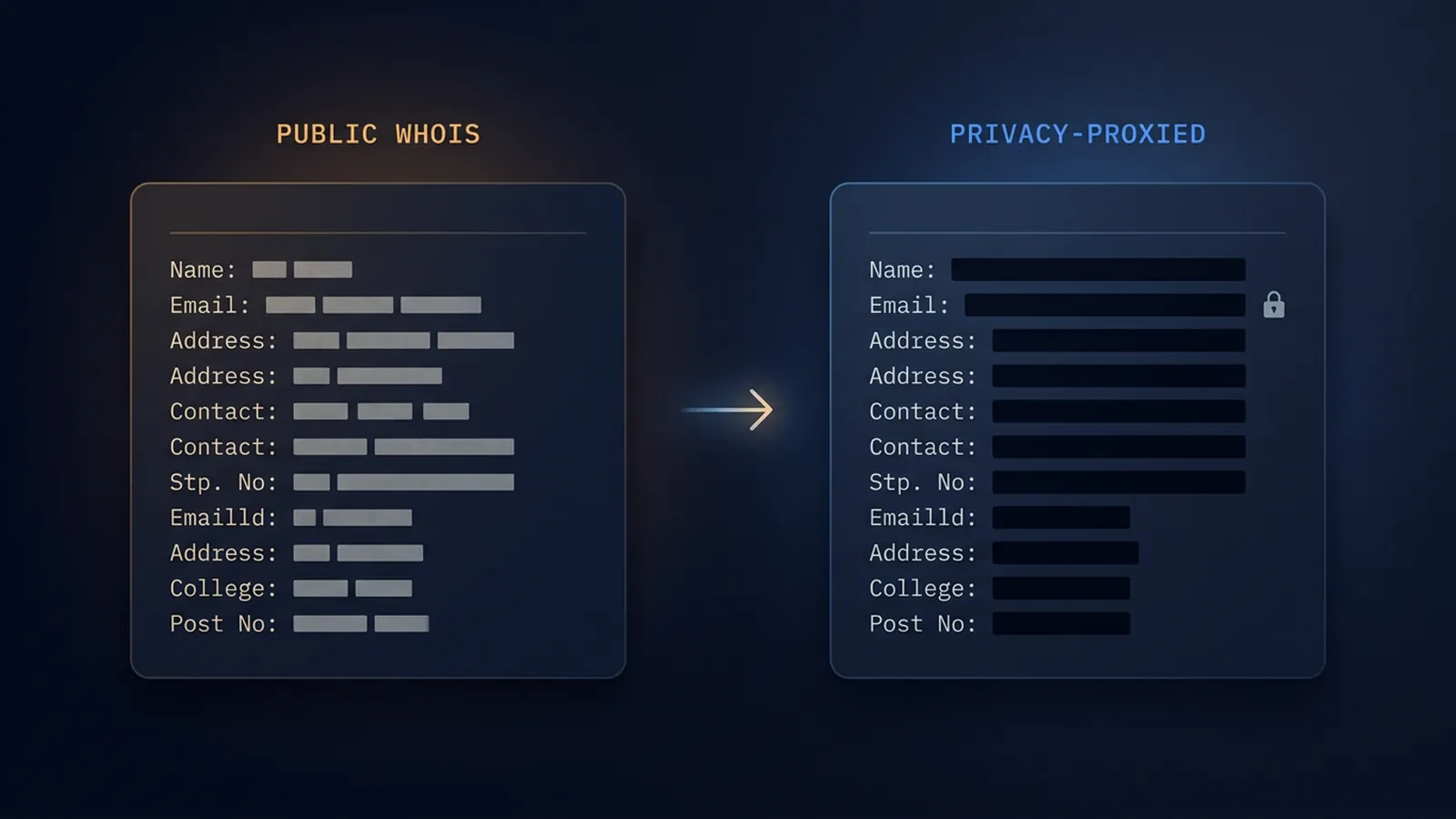
Layer 1: privacy proxy at the registrar
The first and easiest layer is the WHOIS-privacy service that most registrars offer.
How privacy proxies work
The registrar (or a partner) becomes the technical registrant of record and forwards email / postal mail to you. WHOIS queries return the proxy's contact details, not yours. This is what "free WHOIS privacy" means on most modern registrars.
What it protects against
Privacy proxies defeat the casual observer, the dragnet scraper building registrant lists for spam, the journalist running a whois lookup, and the average litigant who hasn't yet retained counsel. For 90% of threat models this is plenty.
What it does not protect against
A privacy proxy does not protect against the registrar itself, against a court order to the registrar, against an ICANN-policy disclosure request, or against the registry under subpoena. The proxy is opaque to the public; it is transparent to the legal system. Anyone who can serve process on the registrar can lift the veil.
Layer 2: TLD jurisdiction matters more than you think
The TLD's registry has ultimate authority over the domain. If the registry is in a country that cooperates with US courts on routine matters, the domain itself is seizable regardless of where you registered it. Pair this section with our jurisdiction guide.
TLDs to avoid for anonymous use
- .com, .net, .cc, .tv — Verisign (US). Routinely seized under US court order. ICE has seized hundreds of domains historically without notice to the registrant.
- .org, .info — PIR / Afilias (US). Similar exposure.
- .io, .ai — administered through UK-linked agreements with sunset clauses (.io is being retired between 2025-2031). Avoid for long-term anonymous use.
- .us, .gov, .edu — direct US jurisdiction. Obvious.
TLDs that genuinely protect against extra-territorial seizure
- .is (Iceland) — registry is ISNIC in Reykjavík. Requires real identity at registration but the records are not disclosed without a formal Icelandic court order, and Icelandic courts have repeatedly declined US extraterritorial seizure requests. Strong for press-freedom and free-speech use cases.
- .ch (Switzerland) — SWITCH. Strong privacy regime, requires Swiss representative for non-residents.
- .me (Montenegro) — local registry, no US ties. Permissive registration, popular for anonymous projects.
- .ru (Russia) — RU-CENTER. Effectively zero cooperation with foreign civil seizure requests since 2022.
- .ro (Romania) — RoTLD. EU-based but with strong independence; requires no identity verification and historically protective of registrants.
- .li (Liechtenstein) — SWITCH-administered; strong privacy similar to .ch.
Special note: free TLDs
Freenom's .tk, .ml, .ga, .cf and .gq were popular for anonymous use until 2023. As of 2024 Freenom is effectively defunct following litigation; do not register new domains there.
Layer 3: payment privacy — crypto isn't automatic anonymity
Paying in Bitcoin is not anonymous; paying in Monero is. The host's checkout sees the coin you sent, and the chain analysis world sees everything that ever happens on a transparent ledger. Pair this section with our crypto payments guide for the full coin-by-coin comparison.
The payment-side leaks
If you pay in BTC from a wallet that has previously touched a KYC'd exchange, the chain-analysis firms (Chainalysis, Elliptic, TRM Labs) can attribute the payment to you. The registrar then has a record linking your domain to the BTC address, the BTC address to your exchange identity, the exchange identity to your government ID. Bitcoin makes you discoverable years later by anyone with a subpoena and a chain-analysis subscription.
The Monero path
Monero (XMR) is the only widely-supported coin with privacy by default at the protocol level. Pay from a fresh wallet funded via a swap that does not record your identity (atomic swap, or a swap through XMR.com or similar), and the payment trail terminates at the Monero protocol boundary. The registrar knows it received Monero; nobody knows where the Monero came from.
The practical sequence
- Acquire XMR cleanly — atomic swap from BTC, peer-to-peer cash purchase, or mining. Avoid KYC'd centralised exchanges.
- Hold in a fresh wallet for a few days. Monero protocol mixing improves with elapsed time across blocks.
- Pay the registrar from this fresh wallet in a single transaction.
- Use a separate wallet for renewal payments. Reusing the same wallet across years is a soft heuristic that links the domain to a persistent identity.
The operational pitfalls that leak you anyway
You can buy a Romanian domain with Monero through a Panama-registered registrar and still leak your identity through any of these:
- Email address. If the contact email is
[email protected], the registrar's internal record contains it and Gmail will hand it over under US subpoena. Use a privacy-respecting mail provider (Proton, Tutanota) on a domain unrelated to your real identity, or self-host as covered in our mail hosting use case. - Reused contact phone. Same logic. Use a VoIP number bought with crypto or skip the phone entirely if the TLD permits.
- Abuse contact pointing to your real email. Many registrars require a separate technical / abuse contact. Use the same anonymous email here; do not split.
- DNS leaks. If the domain's nameservers are at a US provider (Cloudflare, AWS Route53), that provider has a record. Use the registrar's own nameservers, or a privacy-friendly DNS provider in a jurisdiction matching your TLD choice.
- Browser fingerprint during purchase. If you browse the registrar's checkout from a residential IP and a logged-in Google session, the registrar's analytics provider may know who you are. Order from Tor or a clean session.
- Renewal payment via card. A few years in, the credit card you used for an unrelated service auto-bills a renewal because you forgot to update the saved payment method. Set up auto-pay only with the same anonymous crypto method.
- Real-name SSL certificate. Free certificates from Let's Encrypt are fine. Paid extended-validation (EV) certificates require identity verification — never use one on an anonymous domain.
- Posting from the domain on a tied account. The classic mistake: the anonymous-domain blog gets cross-posted on a real-name Twitter account that nobody else would have known about. Operational hygiene is harder than technical hygiene.
The full anonymous-domain stack: a checklist
Put it all together. For a domain you actually want to be anonymous in 2026:
- TLD: .is, .ch, .me, .ro, .ru, or .li — depending on jurisdiction match with the host. Avoid .com, .net, .org, .io for high-stakes work.
- Registrar: incorporated in the same jurisdiction as the TLD, or another friendly jurisdiction. Accepts Monero. Provides WHOIS privacy by default.
- Payment: Monero from a fresh wallet, funded via atomic swap or P2P. Never via a KYC'd exchange.
- Contact email: on a privacy-respecting provider, on a domain unrelated to your identity. Bonus: self-hosted on the same offshore VPS.
- Phone: skip if the TLD allows. Otherwise crypto-funded VoIP.
- Nameservers: registrar's nameservers, or a privacy-friendly DNS provider in a friendly jurisdiction. Not Cloudflare for the highest-stakes work.
- Hosting: matched to TLD jurisdiction or another friendly jurisdiction. VPS or dedicated in Iceland, Panama, Moldova or similar.
- Operational hygiene: Tor or clean-session checkout, no real-name account cross-linking, paid renewals via the same anonymous payment method.